
As users, we are becoming increasingly aware of our privacy. We accept cookies less frequently, and with web browsers beginning to block them by default, a key question arises for any digital business: What impact does this have on my strategy? The answer is simple: a fundamental shift in how data is collected and analyzed.
To understand this new scenario, we first need to be clear on what cookies are.
Cookies are small text files that websites store in each user’s browser. Their main function is to remember information about the user’s activity, such as preferences, items in a shopping cart, or login details. This allows the website to offer a smoother, more personalized experience.
In this new paradigm, browsers are increasingly blocking cookies. Firefox has been doing this for some time, Apple has implemented similar measures in iOS (blocking parameters like gclid and fbclid in the latest iOS 26), and Google Chrome—the leading browser—is following the same path with plans to phase them out gradually.
Analytics without cookies
With the progressive blocking of cookies, the traditional way of collecting data and analyzing digital campaign performance is becoming obsolete. However, respecting user privacy does not mean we should stop measuring. This is where cookieless analytics comes into play.
One of the most advanced solutions for managing user consent is Google’s Advanced Consent Mode v2. This tool allows you to classify users into two groups, adapting measurement according to their consent decision:
- Users who accept cookies (and are not on a browser that blocks them). These users can be assigned a unique identifier, allowing full tracking of their session and behavior over time—even if they return to your site days later from the same browser (without having deleted the cookies). This provides a complete, detailed view of their journey.
- Users who do not accept or reject cookies. This group cannot be assigned an identifier and cannot be tracked directly. But this does not mean you lose all interactions with your site. Advanced Consent Mode v2 allows anonymous event collection while preserving user privacy, though an additional step is needed to interpret this data.
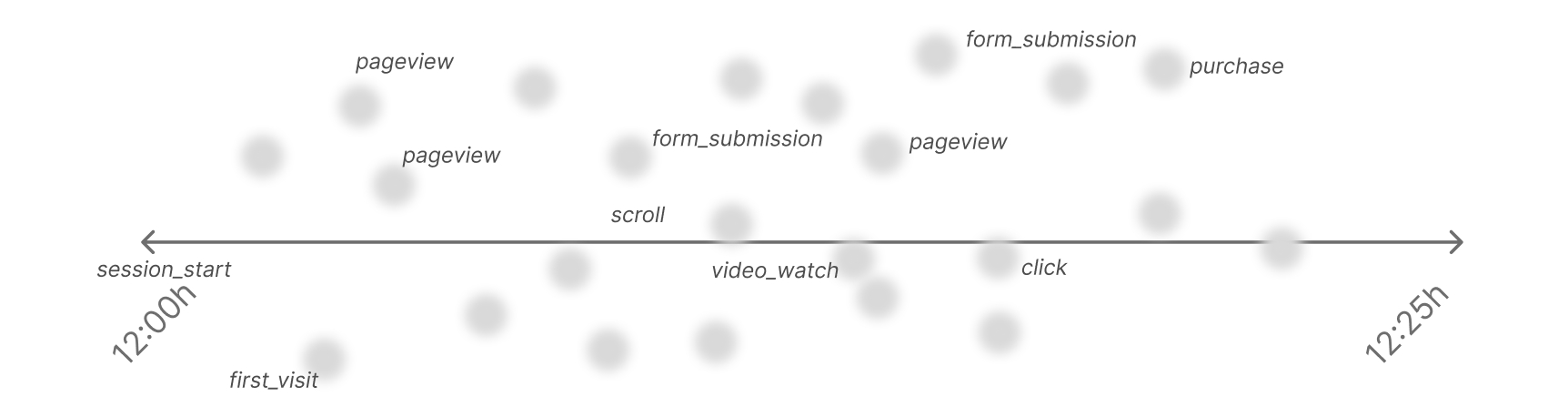
Image: We have the events (gray points), but the connection between them is lost.
To make sense of these data points and reconstruct user sessions, an external solution is needed to analyze and model the information.
At LaMagnética, we have developed a reconstruction algorithm that, based on non-identifiable and public data (such as browser type, operating system, or city), groups different events and pageviews into a single session.
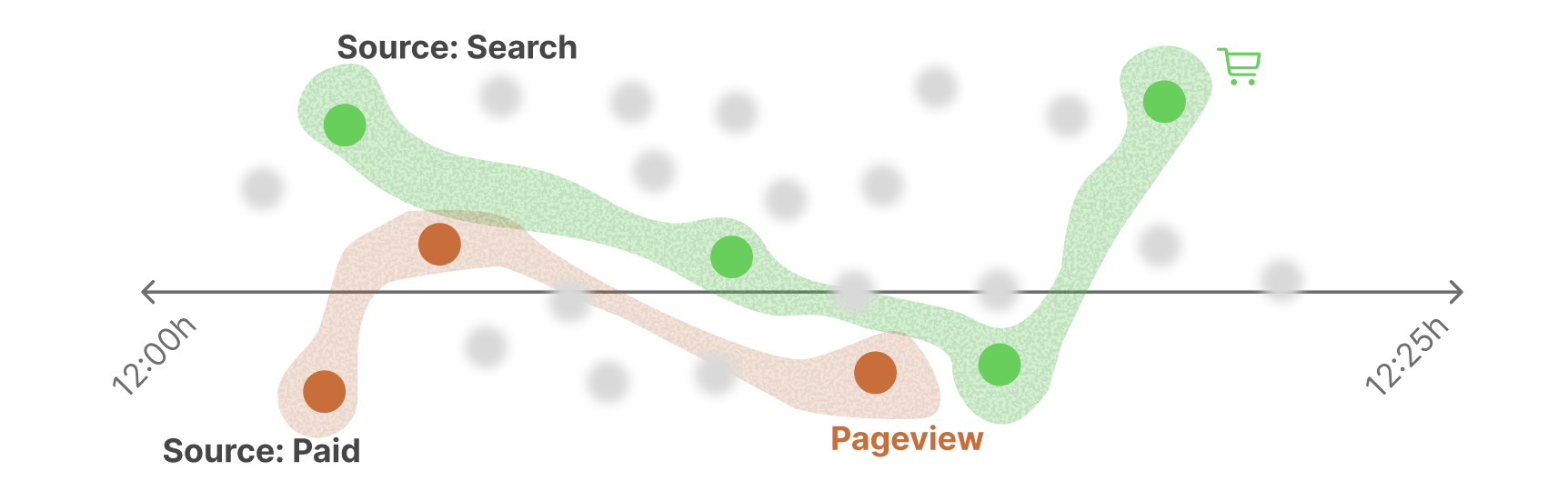
Image: Reconstructed sessions (green and red), respecting the user’s consent choice.
Why is this reconstruction so important?
Machine learning algorithms that optimize advertising campaigns need data to train effectively. When cookies are blocked, these algorithms lose a large portion of conversion information, preventing them from optimizing performance and allocating budget efficiently.
Analyzing the behavior of users who do not accept cookies is crucial for any business. Without this, key information from a significant portion of web traffic is lost.
Imagine a user arrives on your site via an ad campaign but rejects cookies. Even if they purchase a product, that sale cannot be attributed to the campaign, distorting performance metrics and ROI. The data will confirm the purchase, but the source of the user remains unknown, making strategic decisions harder.
With a solution like the one we have developed at LaMagnética, you can measure traffic and campaign performance more accurately, gaining a fuller view of what happens on your site. This approach not only respects user privacy but also provides more reliable data to optimize marketing and sales strategies.
This new landscape forces us to adapt. If this change raises questions or you want to implement our cookieless analytics solution in your business to obtain more accurate data, contact us. We have helped over 20 clients adjust to this new environment while continuing to measure their results precisely.


